
If you’ve started looking into dividing up a warehouse, factory or storage area, you’ll have run into the same fork in the road most of our customers do: mesh or solid. Both are steel. Both bolt together and bolt to the floor. Both can be designed, quoted and installed within a couple of weeks. But they solve genuinely different problems, and picking the wrong one for your situation tends to show up as a frustration you live with for years rather than a mistake you notice on day one.
This guide works through the real differences between mesh and solid partitioning, where each one earns its place, and how to think about the decision when your needs sit somewhere in the middle, which is more common than you’d expect.
What We Mean by Mesh and Solid
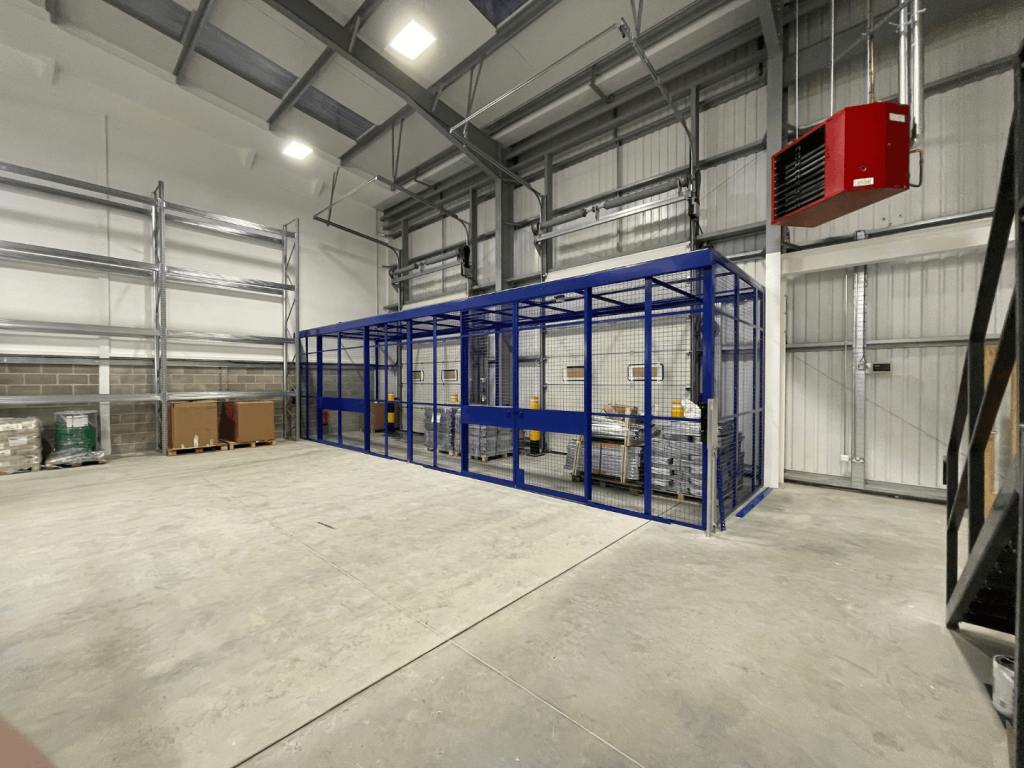
Mesh partitions are exactly what they sound like: a steel mesh panel system that bolts together to form a secure enclosure while remaining fully see-through. They’re one of the most popular systems we install, largely because they solve a problem that solid partitioning simply can’t: creating a secure, lockable area without cutting off light, airflow or sightlines. Our dedicated page on mesh partitions covers the full range of configurations, from open access points to sliding doors and mesh roofing for complete enclosure.
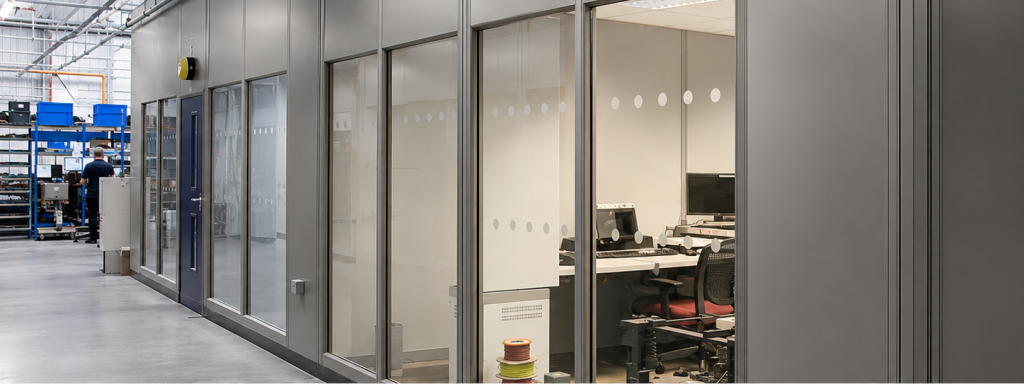
Solid partitioning covers a wider family of products, but the core idea is a continuous steel panel wall rather than an open mesh. This includes single skin steel, which is the cost-effective workhorse for most factory and warehouse dividing, and double skin steel, which sandwiches insulation between two steel faces for better noise control, temperature retention and a more finished look. If you’re trying to decide between those two solid options specifically, our piece on single or double skin steel partitions goes into that comparison in detail.

Security: A Closer Look at What Each System Actually Prevents
Both mesh and solid partitions create a physically secure, lockable boundary, but they secure against different things. A solid partition stops someone seeing what’s behind it as well as stops them getting to it, which matters if you’re storing high-value stock you’d rather not advertise to anyone walking past. A mesh partition stops access just as effectively while leaving the contents fully visible, which matters for a different reason: it lets staff, supervisors or security patrols see at a glance that a cage is intact, undisturbed and correctly stocked, without needing to open it up to check.
This is why mesh tends to be the default choice for warehouse cages and secure storage compounds, covered in more depth on our warehouse cages page, where visibility supports security rather than working against it. Bonded goods, hazardous materials such as paints and gas containers, and high-value stock in distribution hubs are all commonly stored this way, precisely because a locked mesh cage is easy to monitor from a distance and hard to tamper with unnoticed.
Solid partitioning earns its place in security terms where the goal is closer to confidentiality than surveillance. If the concern is stopping people from seeing sensitive stock, documents, or processes rather than simply stopping them accessing it, a solid wall does a job mesh was never designed to do.
Visibility and Light: The Case Mesh Almost Always Wins
There’s no getting around this one. If natural light and sightlines matter anywhere near as much as security, mesh is the stronger option in nearly every scenario. Warehouses and factories often rely on daylight travelling across large floor areas from a limited number of windows or rooflights, and a run of solid partitioning can turn what used to be a bright, open working area into a series of darker, more enclosed sections that need additional artificial lighting to compensate.
Mesh avoids this entirely. Air and light both pass through freely, which also helps with ventilation in spaces where dust, fumes or general air quality matter, and it keeps sightlines open across the floor so supervisors and forklift drivers can see what’s happening in adjoining areas rather than working around blind corners created by solid walls.

Noise, Temperature and Occupied Spaces
This is where solid partitioning, particularly double skin steel, has a clear advantage that mesh simply cannot compete with. Mesh does nothing to block sound or contain temperature, since air passes through it as freely as light does. For a secure storage cage or a perimeter compound, that’s rarely a concern. For an occupied space, such as an office carved out of a warehouse, a quality control room next to a noisy production line, or a break area that needs to stay warm, it’s a different story entirely.
Double skin steel partitioning, with insulation between the two steel faces, is the system of choice wherever people are working inside the partitioned space and noise, dust, or temperature control genuinely matter. Areas of production that are loud or generate significant dust or fumes are commonly isolated this way, sometimes with their own extraction systems built in, so the rest of the working environment isn’t affected. If noise and air quality are driving factors in your decision, solid steel isn’t just the better option, it’s really the only one on the table between these two systems.
Speed, Reconfiguration and Changing Needs
Both mesh and solid steel partitions are modular, demountable systems that bolt together rather than being permanently fixed, which means either can be reconfigured, extended or relocated as your needs change without the disruption of a traditional stud wall rebuild. Mesh tends to have a slight edge here for pure speed, since a mesh compound can often be erected and dismantled quickly, which is exactly why it’s also used for temporary applications like crowd control at exhibitions and outdoor events, alongside its more permanent role in warehouse storage.
Solid partitioning, and double skin systems especially, is a somewhat more involved installation, given the additional panel layers and insulation, but it remains fully demountable and reconfigurable when business needs shift, machinery is replaced, or a production layout changes.
Cost: What Actually Drives the Difference
Mesh partitioning is generally the more cost-effective option of the two, largely because it uses less material and involves a simpler panel system. Single skin steel sits in a similar cost bracket for straightforward dividing work, while double skin steel carries a premium reflecting the additional steel, insulation and finish quality involved. Where the specification calls for viewing panels, sliding doors, mesh roofing for full enclosure, or a mix of glass and steel panels, the price moves accordingly in either system, so a like-for-like comparison always depends on the exact specification rather than the base product alone.
The more useful way to think about cost is against the problem you’re actually solving. A mesh compound that costs less but genuinely meets your security and visibility needs is the right spend. A solid partition that costs more but is the only system that actually blocks noise or contains temperature is also the right spend, even at the higher price, because the cheaper mesh option simply wouldn’t do the job.
When Businesses Combine the Two
It’s worth saying plainly that this often isn’t an either-or decision. Plenty of the projects we install use both systems side by side, applied to the parts of the building where each one actually earns its place. A distribution warehouse might use mesh cages for bonded and high-value stock storage, while using double skin steel to build out an office or a quiet quality control area elsewhere on the same floor. A workshop might use part-mesh, part-solid panels within a single partition run, letting light into a supervisor’s office while keeping a spray or finishing bay fully enclosed, an approach we cover in more detail on our workshop partitions page.
If you’re planning a larger reorganisation of warehouse or factory space rather than a single partition run, our guide on how to divide warehouse space for maximum efficiency and our broader roundup of warehouse partitioning ideas both cover how mesh, solid, and other systems typically get combined across a working site.
A Simple Way to Decide
If you strip the decision back to first principles, it usually comes down to answering one honest question about each area you’re dividing: does this space need to be seen into, or does it need to be shut off from view? If the priority is monitoring, ventilation, natural light, or speed of installation, mesh is very likely your answer. If the priority is noise control, temperature retention, confidentiality, or a fully enclosed, finished-looking space for people to work in, solid steel, and likely double skin, is the stronger fit.
Where different areas of the same site have different answers to that question, which is common, the right outcome is usually a combination rather than a single system applied everywhere out of convenience.
Durability and Day-to-Day Wear
Warehouses and factories are unforgiving environments, and both systems are built with that in mind. Mesh partitions bolt together and bolt to the floor, with additional strengthening built into longer runs specifically to withstand the knocks that come with forklifts, pallet trucks and general daily traffic. It’s a system designed from the outset to take a hit and keep doing its job, which is exactly why it holds up so well as perimeter fencing and secure compounds in busy operational areas.
Solid steel partitioning is equally robust in the areas it’s designed for, though the nature of the wear differs. A continuous steel panel takes an impact across a wider surface rather than a mesh grid absorbing it at multiple points, and where an area sees regular vehicle or heavy trolley traffic close to the partition line, that’s worth factoring into the specification and finish chosen. Both galvanised and powder-coated finishes are available across the range, giving a durable surface that holds up well against the wear and tear of daily industrial use while still looking presentable.
Planning Permission and Building Considerations
One advantage both systems share, and one that’s easy to overlook when weighing up mesh against solid, is that neither typically involves the disruption of a traditional stud wall build. Both are demountable rather than permanent structures, which generally keeps them outside the kind of building work that would otherwise require planning consideration, and both can be installed with minimal disruption to an operational site. This matters in practice: a business rarely wants to shut down a working warehouse for a fortnight just to divide up some floor space, and the modular, bolt-together nature of both mesh and solid steel partitioning is specifically what avoids that.
Where the two diverge slightly is in the scale of the installation itself. A straightforward mesh cage can often go up in a day or two, while a larger double skin steel partition run, particularly one involving glazing, doors and a finished decorative appearance, understandably takes longer to design, manufacture and fit. Neither timeline is prohibitive, but it’s worth factoring into your planning if you’re working to a tight deadline.
Getting the Right Advice for Your Space
Every partition project we take on starts with a free site visit, where we look at the space, talk through what you’re actually trying to achieve, and put together CAD visualisations alongside a fixed-price quote. That conversation is the fastest way to settle the mesh versus solid question properly, since it accounts for your building, your stock, and how the space is actually used, rather than trying to answer the question in the abstract.
If you’re weighing up mesh against solid partitioning for your own site, get in touch with our team or call us on 0115 939 7572 to arrange a free design consultation, or request a quote online to get your project moving.